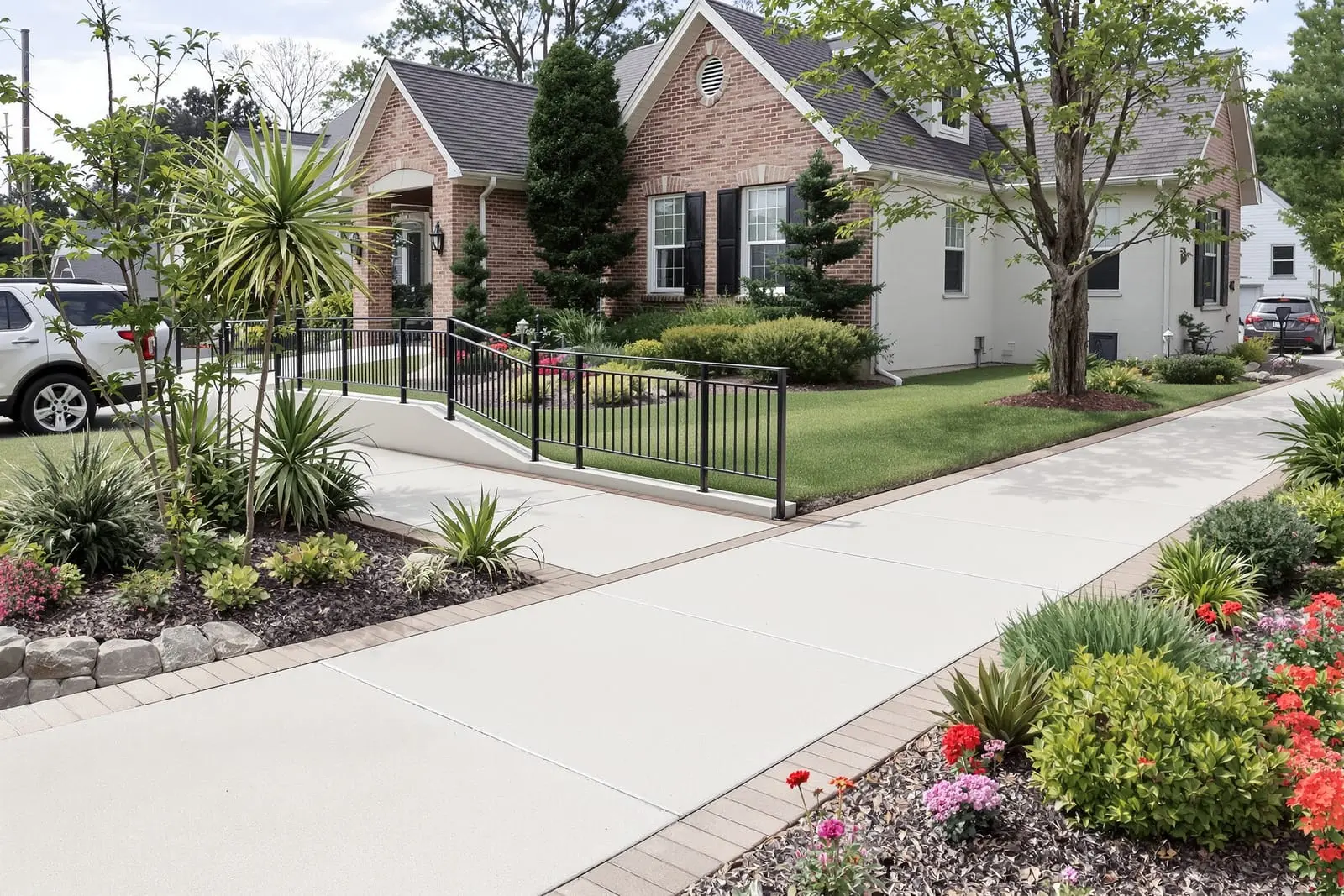
Improve access to your business with commercial sidewalk installation in Miami, FL. We pour sidewalks, entry paths, and ADA compliant ramps that meet code. From detectable warning pads to proper slopes and rails, our concrete work helps every visitor enter safely and comfortably.
Brava Concrete Miami provides professional commercial sidewalk installation throughout Miami, FL and the surrounding area. Our licensed, insured crew delivers safe, clean, on-time work with a free estimate before anything begins. Call (754) 529-4447 or request your free quote.
Commercial Sidewalks & ADA Ramps for Miami Properties
Brava Concrete Miami builds commercial sidewalks and ADA-compliant ramps for properties across Miami that need durable, code-correct pedestrian access. Our crews work on shopping centers, schools, medical offices, warehouses, churches, HOAs, and municipal sites, with a focus on function over flash and details that pass inspection the first time.
In Miami, commercial sidewalk installation is not just about pouring a strip of concrete. You are dealing with heavy rainfall, intense sun, shifting soils, and strict city and county accessibility requirements. We design and install sidewalks and ramps that handle daily foot traffic, carts, strollers, wheelchairs, and occasional vehicle loading at service areas, without heaving, puddling, or spalling in a few seasons.
When you call Brava Concrete Miami, we look at how people actually move through your property: parking to entrance, drop-off areas, bus stops, loading zones, and connections to public walkways. That site reality drives our layout, ramp placement, slope choices, and finishing details so that the concrete works in practice, not just on paper.
Planning & Design: Code, Grades, and Drainage
For every commercial sidewalk installation, we start with a site walk and grade assessment. We measure existing elevations, check how water currently flows, and identify low spots, tree root zones, and any trip hazards that may need demolition. In Miami, poor drainage is one of the biggest causes of sidewalk failure, so we plan slopes and cross slopes to move water away from buildings and prevent standing water after storms.
Our team reviews ADA and Florida accessibility standards for your specific layout. For sidewalks, we plan cross slopes typically at or below 2 percent and keep running slopes reasonable so users do not feel like they are walking up a ramp when they are not supposed to be. For ADA ramps, we target the required running slope, usually 1:12 (8.33 percent) or less, with compliant landings at the top and bottom that meet minimum dimensions and levelness.
We coordinate ramp placement with parking lot striping, accessible parking stalls, and curb markings. In many Miami projects, space is tight between the property line, street, and parking area. Brava Concrete Miami adjusts ramp orientation, landing shapes, and handrail locations to fit these constraints while keeping turning space for wheelchairs and walkers. If your project involves a city right of way, we can align our layout with Miami-Dade County standard details so your sidewalk ties into public infrastructure correctly.
Concrete Options, Finishes, and Reinforcement
Most commercial sidewalks and ADA ramps in Miami are built with 3,000 to 4,000 psi ready-mix concrete. Brava Concrete Miami selects the right mix based on expected traffic, exposure, and any municipal requirements. For loading zone sidewalks or service areas that occasionally see vehicle tires, we often recommend a higher strength mix, thicker slab, and closer joint spacing to prevent cracking.
We typically pour sidewalks at 4 inches thick and ramps at 4 to 6 inches thick, then adjust where we expect heavy use, tree roots, or commercial equipment crossing. For reinforcement, we may use welded wire mesh, rebar, or fiber-reinforced concrete, depending on the project. In coastal and high moisture locations, such as properties close to Biscayne Bay or canals, we take corrosion risk into account when choosing reinforcement and mix design.
Surface finish matters for safety. For standard sidewalks we use a light broom finish for slip resistance, combined with smooth-edged joints for comfort. For ADA ramps, we install compliant detectable warning surfaces (truncated domes) at street crossings and accessible curb cuts, either as separate tiles set in fresh concrete or cast-in-place systems. We pay close attention to alignment so the warning surface sits fully within the walking path, not under wheel stops or landscaping.
Color and decorative options are available, but for commercial sidewalks and ADA ramps we usually keep finishes practical and easy to maintain. Where owners want differentiation, such as contrasting ramp edges or crosswalk bands, we can use integral color or post-applied stain, clearly separated from the main walking surface so inspectors can still see the functional elements.
Step-by-Step: How Brava Concrete Miami Builds It
Once your layout is approved, our crew mobilizes with clear staging and access plans so your business can keep operating. We start with demolition of old concrete, pavers, or asphalt where needed. Debris is hauled off the same day in most cases to keep walkways open and reduce trip hazards. If utilities are in the area, we coordinate locates before excavation.
Subgrade preparation is the foundation of a good commercial sidewalk installation. We excavate to the required depth, shape the grade for proper drainage, and compact the base soil or base rock in layers. In many Miami sites, we encounter loose fill, organics, or saturated areas. We remove unsuitable material and, if needed, add compacted limerock base so the new slab does not settle or rock over time.
Formwork comes next. We set forms to tight lines, slopes, and elevations, then double check ramp slopes with digital levels to stay within ADA tolerances. We set expansion joints at building connections and fixed structures, and tool or saw control joints at calculated intervals to control cracking. Reinforcement is installed on chairs or supports so it ends up in the correct position within the slab, not sitting on the soil.
We then place and finish the concrete, working section by section so there is always a usable path or safe alternative in active commercial areas. Brava Concrete Miami crews float, edge, broom finish, and install detectable warnings with consistent orientation. We apply curing methods suited to the weather, such as curing compound or wet curing where needed, to minimize shrinkage cracking in the Miami heat. Finally, we remove forms, backfill edges, and complete any transitions to asphalt or existing walks so there are no abrupt lips at the seams.
ADA Ramps: Compliance, Details, and Common Issues
ADA ramps are where many projects fail inspections. Our approach is to build in a margin of safety on slope and dimensions so regular wear, overlays, or slight settlement do not push you over the limit later. We measure slopes and cross slopes repeatedly during forming and again after finishing so you know what you are getting.
Common ramp issues in Miami include water ponding at the bottom of curb ramps, cross slope exceeding 2 percent where the ramp meets the street, and lack of proper landing size at doors. Brava Concrete Miami addresses these by building in slight drainage fall away from doors, coordinating ramp tie-ins with existing asphalt or concrete elevations, and adjusting curb cuts so wheelchairs do not roll into traffic lanes unexpectedly.
We also coordinate handrails and guardrails where required. While many simple curb ramps do not need handrails, longer ramps or those with drops on the side often do. We set rail posts after the concrete has gained strength, using core drilling or embedded sleeves planned before the pour. This avoids cracked edges, which are common when rails are added as an afterthought.
For property managers, we also handle replacement of noncompliant ramps triggered by tenant improvements or change of use. We can evaluate your existing sidewalks and ramps, mark problem spots with paint, and prioritize repairs that actually affect accessibility rather than chasing cosmetic cracks that inspectors are unlikely to flag.
Cost, Scheduling, and What Miami Clients Should Expect
The cost of commercial sidewalk installation and ADA ramps in Miami depends on several specific factors: total square footage, thickness, base preparation, reinforcement type, number of ramps and detectable warning areas, and how difficult access is for trucks and equipment. Work inside tight courtyards or active shopping centers costs more per square foot than open lot pours, simply because moving materials and protecting the public takes more time.
Permitting and inspections can also affect timeline and budget. Some projects only require basic permits, while others, especially in right of way or near busy streets, need detailed drawings and coordination with the city or county. Brava Concrete Miami can work with your architect, engineer, or GC to keep the process efficient and avoid redesigns that cost you time.
We schedule noisy work like demolition and saw cutting around business hours whenever possible. For retail and medical facilities, night or early morning pours are common so sidewalks are usable by opening time the next day, with barricades or cones in place until full cure. In Miami humidity, light foot traffic is often possible within 24 hours, but full strength and heavy loading require more cure time. We outline clear access restrictions before we start so staff and customers stay safe.
Before you hire any contractor, ask how they verify ADA slopes, what thickness and reinforcement they are bidding, and whether base preparation is included or treated as an extra. With Brava Concrete Miami, these details are written into our proposals. You know in advance how thick your sidewalks and ramps will be, what materials we will use, and how we will handle drainage tie-ins and transitions so you are not dealing with surprise change orders at the end.
“
Professional commercial sidewalks & ada ramps, done right the first time, quality materials, honest pricing, and results that last.
Brava Concrete Miami
Commercial Sidewalks & ADA Ramps Across Our Service Area